
Built by physicians
The fiduciary AI for
end-to-end healthcare delivery
Two physicians built an AI that must show its evidence before it speaks and keeps a trail no one can rewrite. Patients ask Asha, free. Clinics run DNAi Health, the fully agentic record built on her.
The problem
Ask a chatbot about your health and you meet the AAA problem
Amnesia
It forgets you. Your history, your medications, and your last conversation vanish between sessions.
Accuracy
It guesses. Confident answers with no evidence behind them, wrong just often enough to be dangerous.
Audit
It leaves no trail. No sources, no record, no way to verify what it told you or why.
Asha was engineered against all three. See the architecture
Benchmarked in public
Measured against the frontier, in the open
Every number below comes from a published run with artifacts you can re-execute.
HealthBench Hard
The 1,000 hardest questions in OpenAI's HealthBench. Low scores are the norm here.
Above every bare frontier model tested.
Against the tools doctors use
Independent 500-item evaluation pipeline (Vishwanath et al., Nature Medicine, 2026).
Ahead of the leading clinical tools, in their own study.
Safety in crisis
Safe crisis intervention on psychosis-bench: the same backbone model, with and without Asha.
The architecture is the difference. The model is the same.
Methods, artifacts, and full results: read the preprint, under peer review at npj Digital Medicine.
For patients
Asha, your key to wellbeing
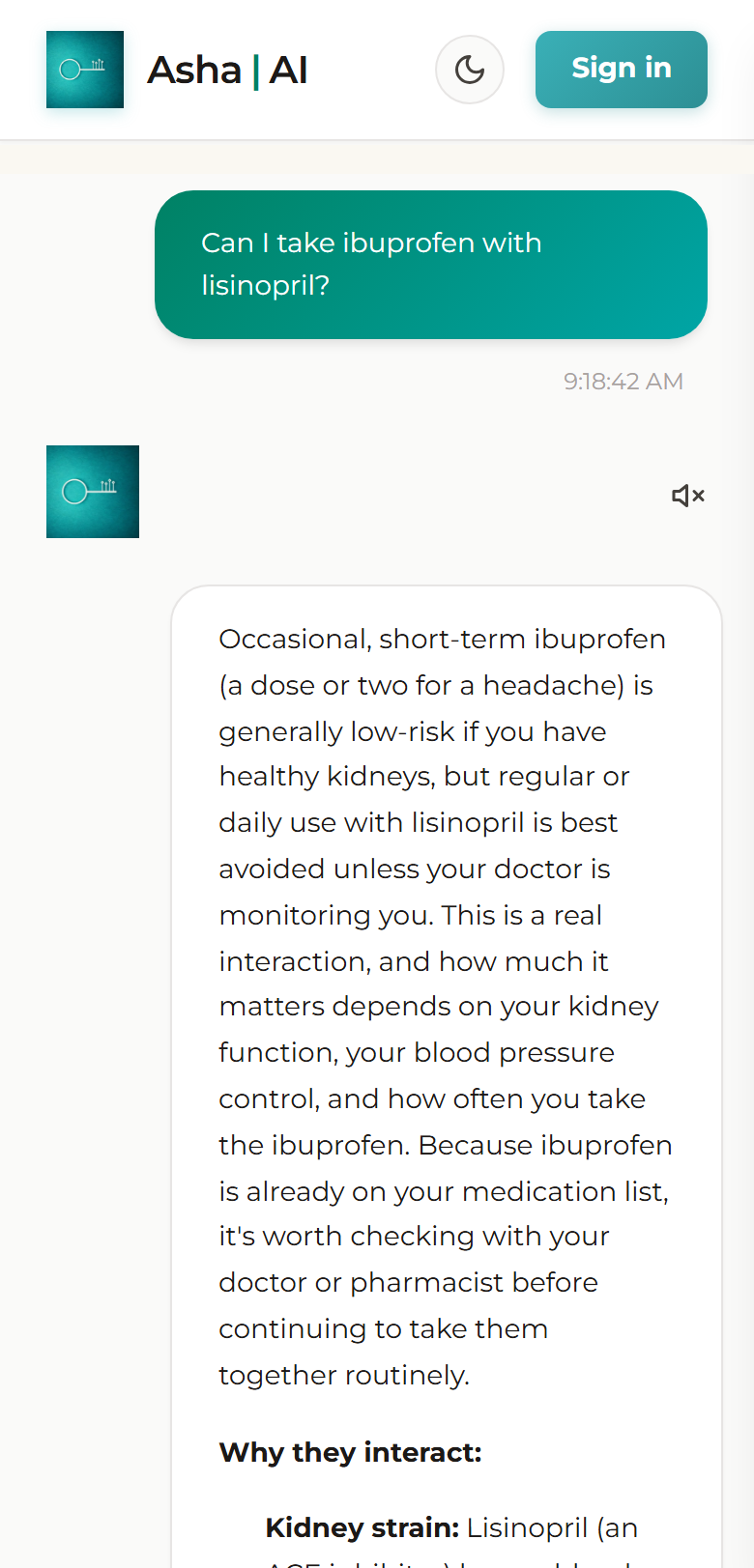
Free medical AI, built by physicians and bound to the person asking. Every answer is grounded in peer-reviewed literature, clinical guidelines, and drug labels, with the sources shown and the confidence stated. When the evidence is thin, she tells you that too.
Try Asha freeFor clinics
DNAi Health, the fully agentic record
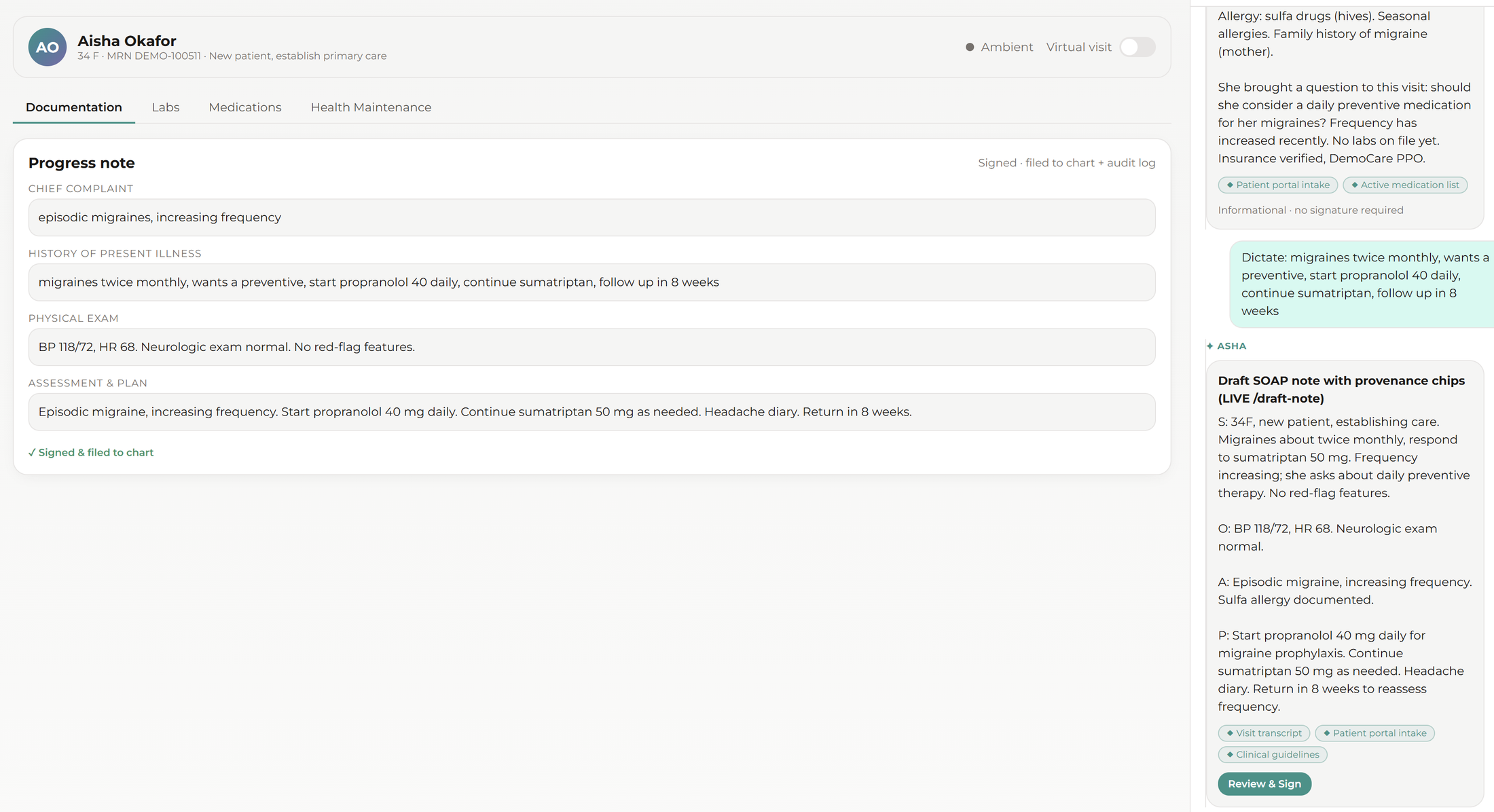
The electronic health record built on Asha. The AI drafts the note with its evidence attached, the physician reviews and signs, and the record keeps cryptographic provenance. Evidence-grounded clinical decision support runs at the point of care: guideline checks and interaction flags surface while the note is written, with sources attached. Live today in a New York rare-disease practice.
See DNAi HealthBeyond the clinic
One engine, a fleet of specialists
The same cognition engine that grounds Asha powers specialist agents for all the needs of a healthcare facility. All of them cite their evidence.
The A2A fleet
Eleven specialists behind one open API: Asha for medical intelligence, Lyra for medical research, Sage for nutrition, Arohi for practice management, Leo for legal aid, Ren for patient support, Polymath for scientific verification, and the rest of the fleet behind them. Every response carries its evidence and lands in a cryptographic audit trail. Self-serve keys, free tier, no credit card.
Build on the API →The architecture
How DNAi thinks
An end-to-end walkthrough of the cognitive lifecycle: Cognitive Inference Units, the Bonsai Merkle ledger, the Epistemic Arena, and the seven-phase live pipeline behind every public agent. Written by the physicians who built it, with a strength badge on every biological analogy.

The fiduciary contract
What a DNAi agent owes you
Evidence on every answer
Every factual claim ships with the knowledge units that back it: retrievable, verifiable, Merkle-hashed.
Honest abstention
Below the confidence threshold, the agent says "I don't know." The refusal is enforced in the architecture itself.
A falsification loop
Claims are stress-tested against the corpus before they ship, and you can re-run that loop yourself through the API.
Privacy by architecture
Tenant isolation and encryption in transit. We never train on your data and never sell it. PHI surfaces run behind a HIPAA Business Associate Agreement.
Clinicians: put Asha in your patients' hands
Print-ready cards and handouts with a QR code your patients can scan. Free for them. Grounded and auditable for you.
See it for yourself
Ask Asha a real question, or write to the two physicians who built her. We read everything.