How DNAi Thinks

DNAi is not a metaphor for biological intelligence — it is an engineered re-instantiation of it, from the atom of meaning to a cybernetic system of eleven specialized agents, with a tamper-evident receipt for every cognitive event.

Read the architecture ↓
Section 1 · The Atom

A unit of meaning, not a unit of text

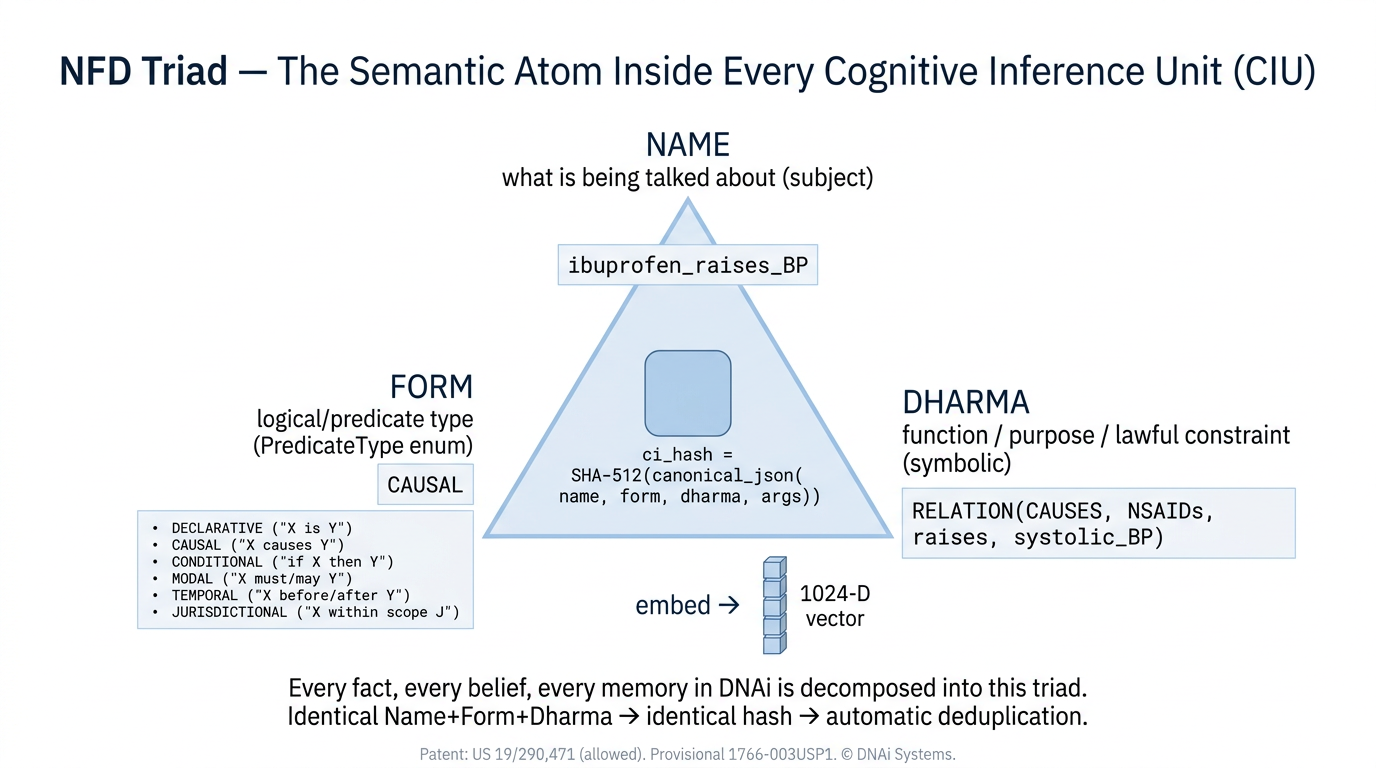
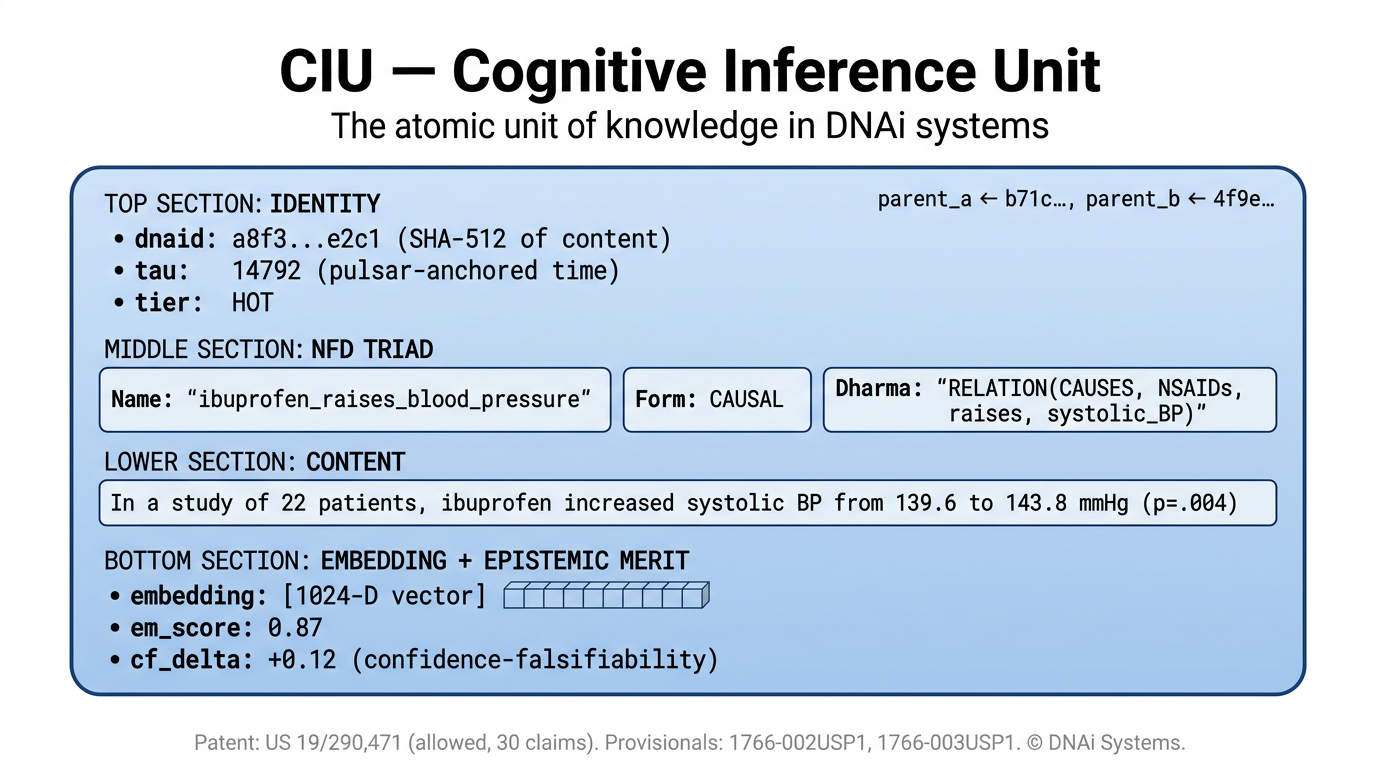
Every thought DNAi has begins as a Competitive Informational Unit — a CIU. A CIU is not a sentence and not a token. It is a propositional commitment built from an NFD triad: a Name (the subject), a Form (declarative, causal, conditional, modal, temporal, or jurisdictional — the predicate type), and a Dharma (the function or lawful constraint the proposition asserts). Identical N+F+D collapses to an identical SHA-512 hash and is automatically deduplicated.

The closest molecular analogue is the codon: a minimal three-slot positional code whose meaning depends on the order and identity of its parts. A codon selects an amino acid; an NFD triad selects a propositional commitment. Both collapse a continuous signal into a discrete, position-sensitive vocabulary that downstream machinery — ribosome or cognition loop — can read. CIUs are the cells of DNAi's mind: each has identity, tier (HOT / WARM / COLD), a merit score, and a contradiction score; each is created, promoted, demoted, or atrophied as a single addressable entity.

The NFD triad — Name, Form, Dharma — DNAi's atomic semantic unit
Metaphorical The NFD triad as propositional atom. Three-slot positional encoding with hash-based deduplication. Standard molecular biology analogue (codon).
A Competitive Informational Unit (CIU) — DNAi's addressable knowledge cell
PartialEngram cells are functional populations co-activated during encoding; optogenetic reactivation produces specific recall (Ramirez et al., Science 2013, 976×). Method note: c-Fos identification has documented false-positive/false-negative rates — DNAi's hash-deterministic CIU identity does not.
Section 2 · The Embedding

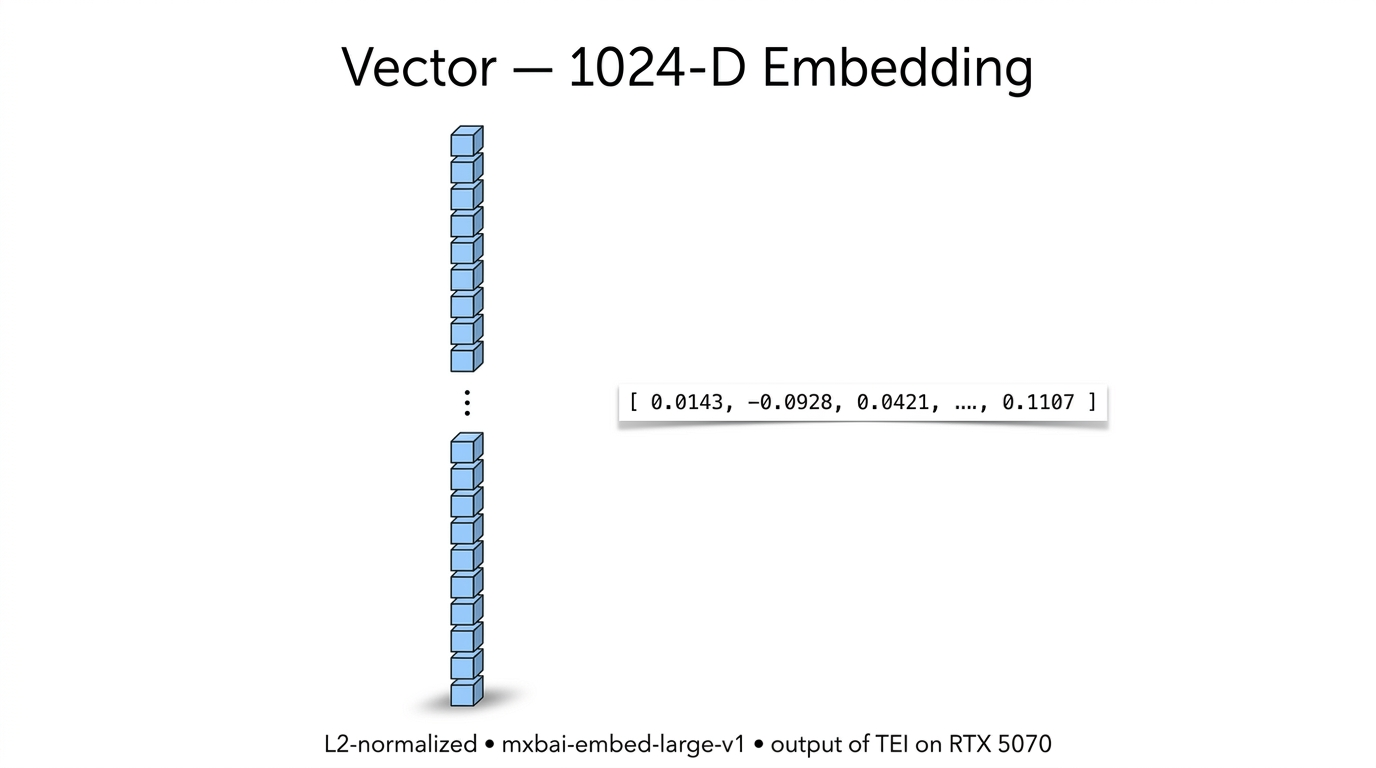
A 1024-dimensional address in semantic space

A 1024-dimensional embedding vector representing one CIU
PartialSparse single-neuron semantic representations documented in human medial temporal lobe (PLoS Biology 2019, 67×). The 1024-D embedding is the digital cousin: high-dimensional, distributed, content-addressable. Quian Quiroga 2005 standard knowledge — corpus contains downstream lineage.
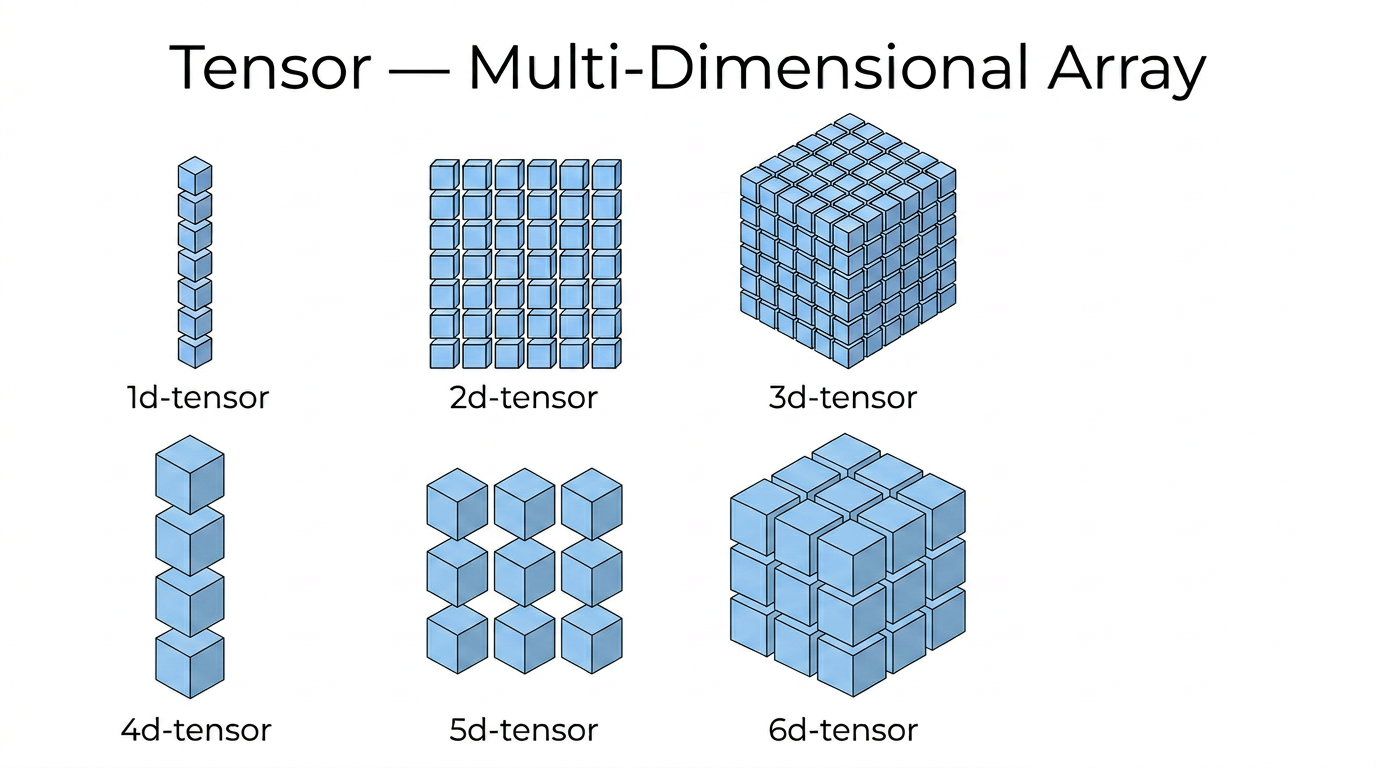
A multi-dimensional tensor of stacked CIU embeddings
PartialTensors stack many CIUs into a single computable shape so the system can reason across them at once.

Each CIU also carries a 1024-dimensional, L2-normalized vector generated by the embedding server. The vector is the CIU's address in semantic space — findable by cosine similarity across 591 Qdrant collections holding more than 121 million vectors. Two CIUs that are conceptually close end up close in this 1024-D space, even when the underlying words are different.

The cortex stores memories the same way in spirit: as sparse distributed representations — activation patterns across populations of neurons, where any concept lights up roughly one to five percent of an ensemble, and any neuron participates in many concepts. The 1024-D embedding is the digital cousin: high-dimensional, distributed, content-addressable. Cortical SDRs are binary-sparse and the embedding is dense float, but the function is the same: meaning lives in the pattern, not in any single coordinate.

Section 3 · The Ledger

Two cells link by hash, not by potentiation

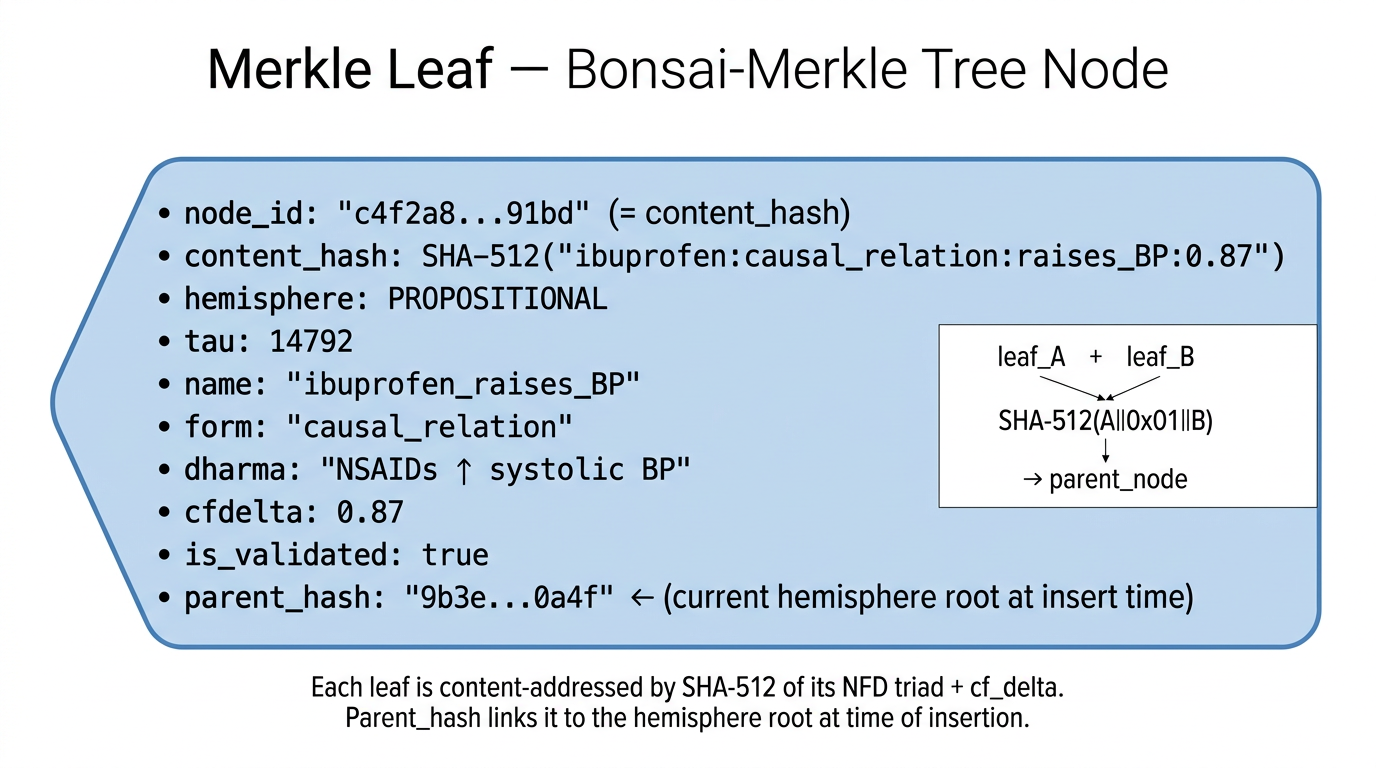
When two CIUs co-resolve in the Epistemic Arena, they are bonded. Not by chemistry — by hash. Each child CIU stores the SHA-512 of its parents at insert time, parent_hash = SHA-512(A ‖ 0x01 ‖ B), under Axiom 25: Ledger Causality. The result is a Bonsai-Merkle tree in which every leaf knows what gave rise to it, and any tampering anywhere in the lineage is detectable from a single root.

The biological analogue is Hebbian plasticity — "cells that fire together wire together" — and its temporally precise refinement, spike-timing dependent plasticity. The Merkle parent_hash is the cryptographic counterpart: CIUs that co-resolve are bonded by hash rather than bonded by potentiation. STDP is continuous, decaying, biochemical; the ledger is discrete, immutable, cryptographic. The deep property both share is history-preserving binary coupling.

A Bonsai-Merkle tree leaf with parent_hash chaining
MetaphoricalSpike-timing-dependent plasticity strengthens synapses by coincident pre/post activity (Markram et al., Science 1997, 3,829×). The Merkle parent_hash is the cryptographic counterpart — immutable, audit-trail rather than rule-modulated. Note: STDP windows vary with cell type, region, and neuromodulation.
Where DNAi exceeds biology. Cryptographic auditability of every cognitive event is one of the few places the system goes beyond what brains can do. Every act of knowing leaves a tamper-evident receipt.
Section 4 · The Tournament

An Epistemic Arena, run as Neural Darwinism

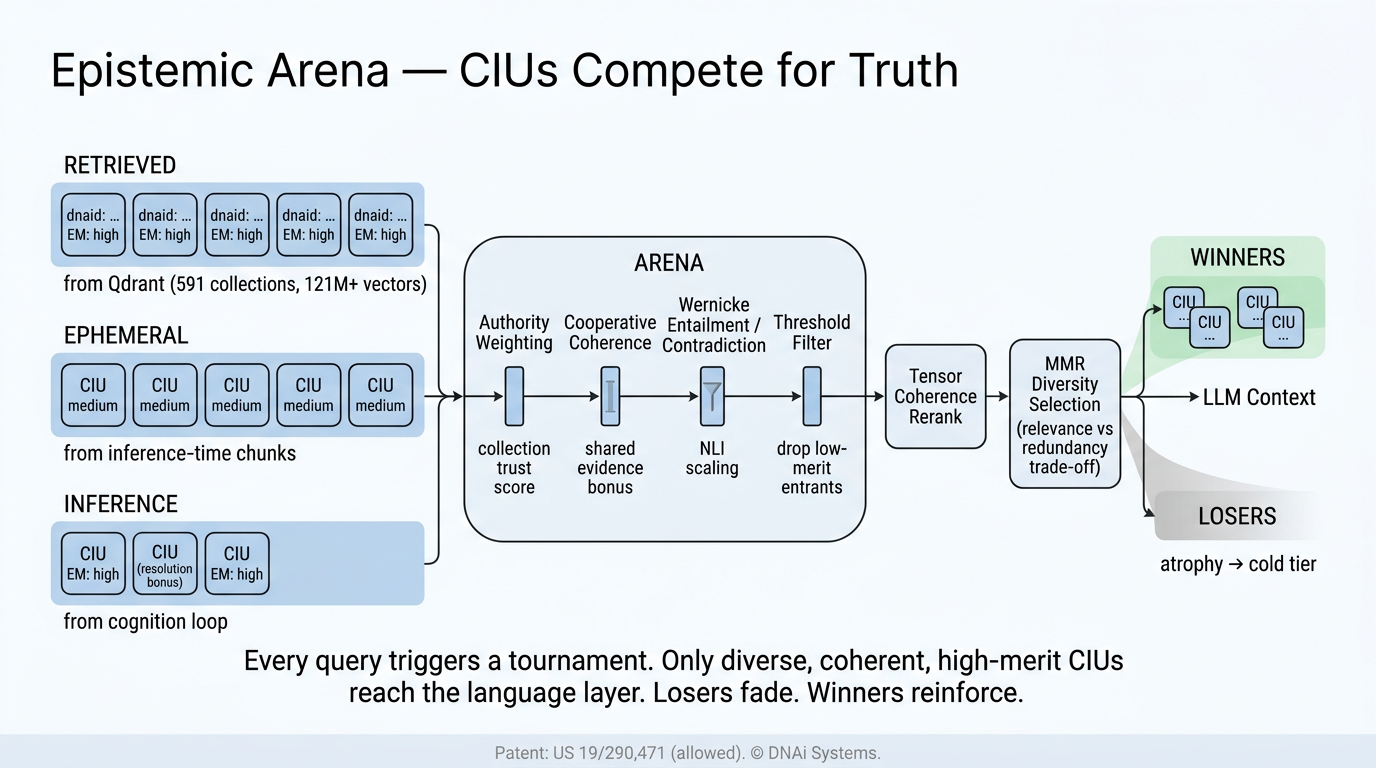
Every query triggers a tournament. Three streams of CIUs enter the Epistemic Arena in parallel: RETRIEVED (drawn from the 591 Qdrant collections), EPHEMERAL (chunked from the inference-time context), and INFERENCE (born from the cognition loop itself). They pass through Authority Weighting → Cooperative Coherence → Wernicke entailment-and-contradiction checks → a Threshold Filter → Tensor Coherence Reranking → MMR Diversity Selection. Winners reach the language model's context. Losers atrophy to the cold tier.

This is an engineered Theory of Neuronal Group Selection. Gerald Edelman's TNGS — Neural Darwinism — holds that the brain develops, learns, and reasons by selectional competition between neuronal groups: variation, differential reinforcement, reentrant signaling. The Epistemic Arena maps directly: variation is the three input streams, differential reinforcement is the merit scoring and arena gates, reentry is the cognition loop's recurrence.

This is the strongest rung in the ladder — corpus-grounded by an explicit AI-side reading of TNGS in IEEE Expert ("Formal minds and biological brains: AI and Edelman's extended theory of neuronal group selection," 22×) and reinforced by the memory-consolidation literature in PubMed (sharp-wave-ripple consensus statement; systematic review and meta-analysis on sleep-driven novel word learning). Both systems are population-level selectional engines. DNAi differs only in substrate — and in observability: every selection event is logged. Biological selection must be inferred post hoc.

The Epistemic Arena — CIUs from three streams compete under merit scoring
ExactEpistemic Arena ≅ Neural Darwinism (TNGS). Both are population-level selectional systems with variation, differential survival, and reentrant feedback. Corpus-grounded.
Section 5 · The Heartbeat

One architecture, two metaphors, one fiduciary cycle

The hero animation at the top of this page is the unified plate — DNAi's cognitive lifecycle rendered as one continuous heartbeat through seven phases. The same architecture has two sister renderings, each a different lens on the same machinery. The cardiac plate frames cognition as systole and diastole — pump, fill, pump again. The encephalic plate frames it as cortical traversal — input, deliberation, response. Same loop. Different metaphor. Same tamper-evident receipt at every phase boundary.

Section 6 · The Cybernetic Top

Eleven agents, one fiduciary canopy, an observer inside the system

DNAi is a second-order cybernetic system in fact, not by analogy. The observer is inside the system: every CIU's merit score and contradiction-flux delta are produced by DNAi's observation of itself, and the Reflexion module re-reads its own outputs and updates its beliefs without an external oracle. Structural coupling is engineered: the eleven agents do not merely share a database — each agent's output becomes another's input, and the rules of mutual perturbation are codified through the A2A protocol, the operational counterpart of Maturana and Varela's autopoietic frame. And cryptographic audit closes the loop: the Bonsai-Merkle ledger makes every act of observation itself observable.

The corpus supports this framing across all three load-bearing properties — autopoiesis as the organization of the living (Varela lineage, Biological Research 2003, 190×), second-order cybernetic methodology (Systems Research 1996, 25×; Syst Res Behav Sci 2001, 48×), and the move from first- to second-order (observer inside the system) as the route to validity in mind-matter systems (2003, 22×). DNAi is what you get when you take that program seriously and add the receipt.

AshaMedical intelligence
HarleyFitness coaching
ArthaFinancial analysis
SageNutrition & wellness
PolymathMath & science verification
LyraMedical research
LeoLegal aid
MiraMarketing & growth
RenCustomer support
ArohiPractice management
RayPlatform architecture
Section 7 · Honest Gaps

We grade our own analogies. Where the corpus does not yet supply receipts, we say so.

Every analogy in the ladder is rated. Exact means the corpus directly grounded the mapping. Partial means the function maps cleanly even when the substrate differs. Metaphorical means we are using a structural analogy in good faith. The dagger marks specific claims that remain standard textbook knowledge not yet directly retrieved from the corpus. A second corpus pass closed four of the six original gaps; what follows is the remaining honest list.

What still carries a dagger

  • NFD triad as codon analogue (Rung 1). Standard molecular biology — out of scope for the medical / scientific neuroscience corpus this work draws on. Honest metaphor, not a defect.
  • Quian Quiroga 2005 Nature specifically (Rung 2). The downstream lineage is corpus-grounded (PLoS Biology 2019, 67×); the foundational 2005 paper itself is held as standard knowledge until verified.

One principled narrowing the corpus forced on us

  • Mini-column → cell-assembly cortex. Columnar organization is documented in primary sensory cortex (J Physiol 2009 anniversary review). Universality across all neocortex is contested by the corpus. DNAi's modular CIU and agent architecture is more analogous to cell-assembly cortex models (Behav Brain Sci 1999, 1,259×) than to a strict mini-column substrate. We took the narrowing.

And two places DNAi exceeds the biology

  • Cryptographic auditability of every cognitive event. No biological precedent. Every minting, promotion, demotion, and parent-link is verifiable from a single Merkle root. Where biology relies on statistical c-Fos identification with documented error rates, DNAi's CIU identity is hash-deterministic.
  • Selectional events that are individually addressable and reversible. Biological selection is statistical and largely irreversible; DNAi selection is logged per-CIU and can be replayed or audited.
Section 8 · What This Is Built On

The receipts beneath the architecture

  • Patent. US 19/290,471 — allowed, 30 claims. Provisionals 1766-002USP1 and 1766-003USP1 in flight.
  • Co-principals. Built by Deepan Singh, MD, FAPA and Paridhi Anand, MD — both practicing physicians.
  • Memory. 591 Qdrant collections holding more than 121 million vectors of curated knowledge — medical, financial, legal, scientific, fitness, nutrition.
  • Governance. 46 axioms plus 7 meta-axioms, with Z-arbitration as the conflict-resolution court of last resort.
  • Interoperability. All eleven public agents accessible via the A2A v1.0 protocol with per-call cryptographic audit and a separate record of audited disagreements.
  • Editorial spine. The micro-to-macro thesis above is corpus-grounded; sources are cited in the appendix of the canonical Lyra document.